
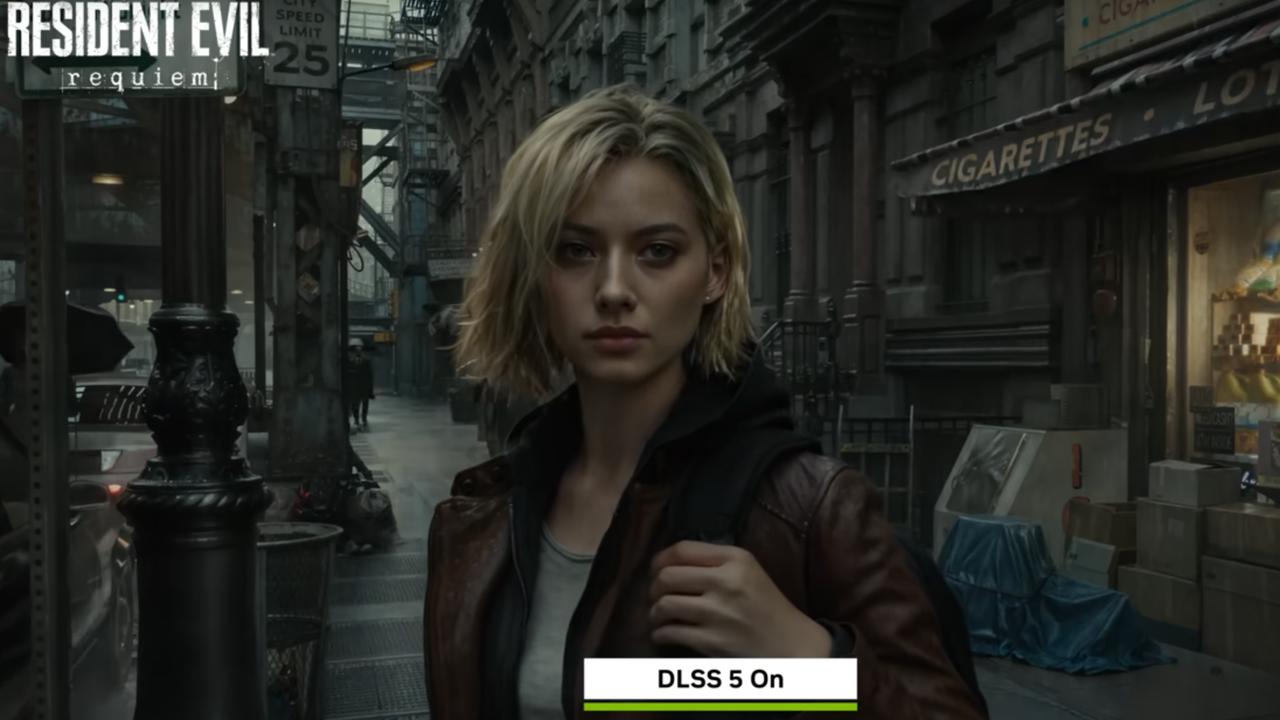
NVIDIA DLSS 5 is here, but is "Neural Rendering" just "AI slop"? Explore the GTC 2026 reveal, the community backlash, and the future of RTX 50-series graphics.
Following the announcement at GTC 2026 earlier this week, the tech world hasn't just been buzzing: it’s been in a state of near-civil war. The catalyst? DLSS 5: Real-Time Neural Rendering.
What started in 2018 as a humble upscaling tool (DLSS 1.0) has officially evolved into what Jensen Huang calls the "GPT moment for graphics." But now that the keynote is over, the official YouTube reveal has a shocking 84% dislike ratio, and a growing "AI Slop" revolt on Reddit shows that gamers might not be ready for a future where their GPUs "hallucinate" the lighting of their favorite videogames.
What is DLSS 5? Moving from Reconstruction to Generation
For years, DLSS was about efficiency. DLSS 2 gave us sharper images from lower resolutions; DLSS 3 gave us "fake" frames to smooth out motion; DLSS 3.5 gave us Ray Reconstruction to clean up noisy light paths. DLSS 5, on the other hand, is a complete change in philosophy. It is no longer trying to show you the game better; it is trying to show you a better version of the game.
According to NVIDIA's technical whitepaper, DLSS 5 uses a real-time neural rendering model. By taking the engine’s raw color buffers and motion vectors, the AI identifies scene semantics, distinguishing between human skin, weathered leather, brushed aluminum, and flowing water. It then "infuses" these pixels with photoreal materials and lighting that the game engine never actually calculated.
"Twenty-five years after NVIDIA invented the programmable shader, we are reinventing computer graphics once again. DLSS 5 is the GPT moment for graphics, blending handcrafted rendering with generative AI."
— Jensen Huang, GTC 2026 Keynote
The Technical Wizardry (and the Catch)
The visual leap is, on paper, staggering. In the Resident Evil Requiem demo, we saw skin with realistic subsurface scattering, the way light enters the ear and glows red, achieved without the massive ray budget typically required for such effects. It’s "Hollywood VFX" in a 16ms frame window.
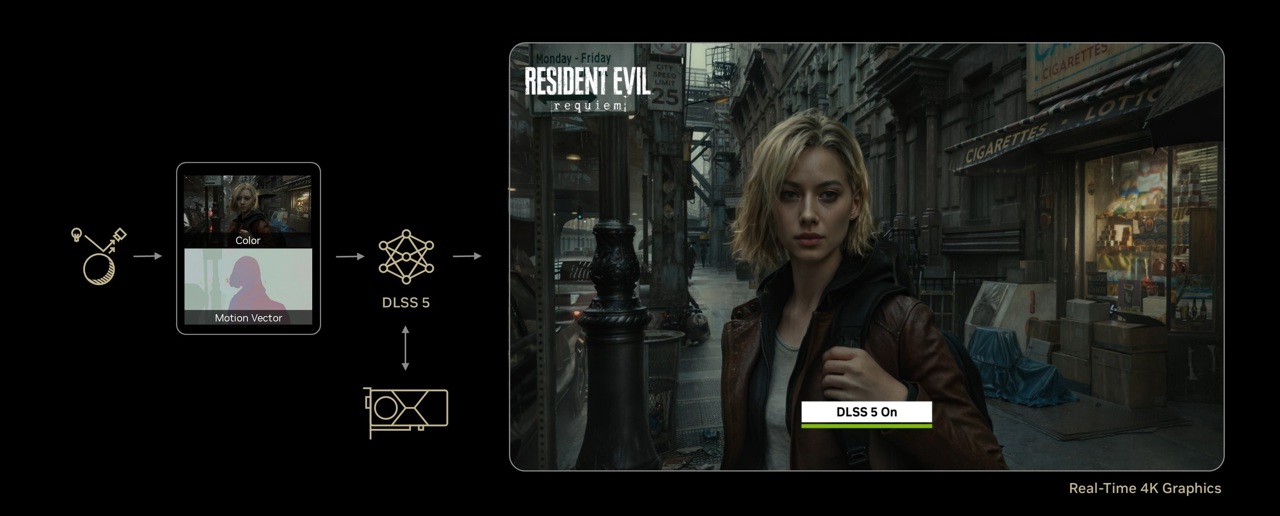
But the hardware requirements for this "magic" are where the debate starts. The live GTC demos were running on a dual RTX 5090 setup. One card was dedicated entirely to rendering the game, while the second was used as a dedicated neural processor for the DLSS 5 model. NVIDIA says it will have an optimized version for a single GPU ready for the launch of the RTX 50 series this fall, but the "AI tax" on VRAM and compute is clearly reaching its limit.
The "AI Slop" Backlash: Why Gamers Are Revolting
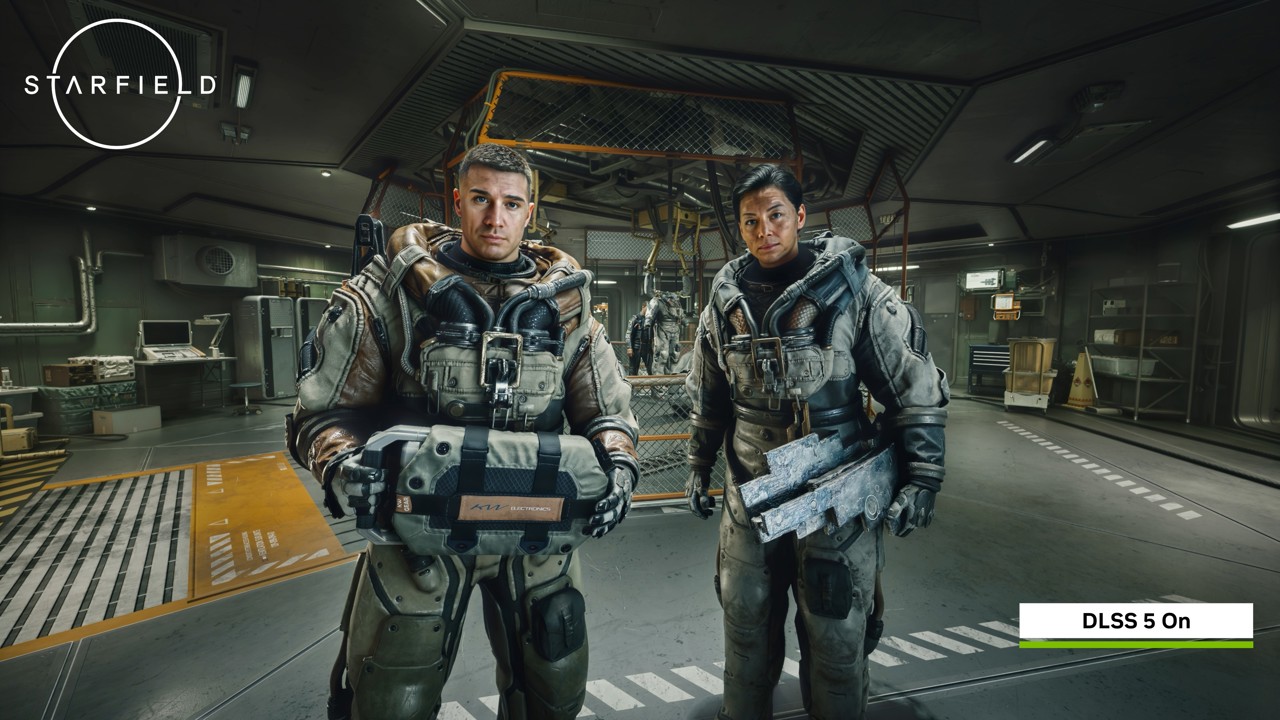
If the tech is so impressive, why is the community reaching for pitchforks? The answer lies in artistic integrity. The most viral (and criticized) moments of the reveal involved "enhancing" character faces in games like Starfield and Hogwarts Legacy. The AI didn't just sharpen the image; it altered facial structures, added wrinkles, changed eye reflections, and arguably "beautified" characters in a way that felt like a TikTok filter.
- Character Erasure: Critics point out that characters like Grace Ashcroft in the Resident Evil Requiem preview looked like entirely different people once DLSS 5 was toggled on.
- Loss of Mood: In the Zorah Demo, the warm, intentional shadow work of the original artists was replaced by "technically correct" but soulless photoreal lighting.
- Cognitive dissonance: While the hair and skin look more "real," the way they interact with the game's stylized animations creates a noise that many are calling "AI slop."
The response from NVIDIA? Not exactly conciliatory. When asked about the criticism that DLSS 5 ignores artistic intent, Jensen Huang told Tom’s Hardware, "They're completely wrong." He argued that because developers have "SDK controls" to mask off areas and tune the AI's intensity, the tech is a tool, not a replacement. But as one Ubisoft developer leaked to Insider Gaming, "We found out about DLSS 5 at the same time as the public." If the developers weren't even in the loop, how can they have "full artistic control"?
In a video response to NVIDIA, Gamers Nexus provides a critical analysis of NVIDIA’s DLSS 5 announcement, detailing how the new generative AI "neural rendering" technology has faced significant backlash for its artificial-looking visuals, noticeable artifacting in early demos, and the extreme hardware requirements of its current preview state.
The Death of Native Rendering?
At Pangoly, we’ve always been supporters of hardware-based performance, but we’re reaching a crossroads. If DLSS 5 becomes the industry standard, the incentive for developers to optimize their games' native rasterization or ray-tracing pipelines effectively vanishes. We’re looking at a future where a game might look like a messy 720p blur "natively," only to be "fixed" by a proprietary NVIDIA AI model.
Current Game Support (Fall 2026 Launch)
| Title | Developer | Enhancement Focus |
|---|---|---|
| Resident Evil Requiem | CAPCOM | Neural Skin/Subsurface Scattering |
| Assassin’s Creed Shadows | Ubisoft | Photoreal Foliage & Global Illumination |
| Oblivion Remastered | Bethesda | Materials & Texture Depth Reconstruction |
| Starfield | Bethesda | NPC Realism & Planetary Lighting |
Conclusion: A Brave New (and Slightly Hallucinated) World
DLSS 5 is more than just a performance toggle; it’s a fundamental shift in what we define as "gaming." For the "frames per second" crowd, the ability to get 4K photorealism on mid-range hardware (eventually) will be a godsend. For the "art as intent" crowd, it feels like the beginning of the end for the traditional relationship between artist and player.
NVIDIA is betting that, just like with DLSS 1 and frame generation, the "moaning" will stop once people see the results on their own monitors. But this time, the AI isn't just drawing the lines; it’s painting the picture. Whether that picture is a masterpiece or a hallucination remains to be seen.
What’s your take? Is DLSS 5 the future of immersion, or is NVIDIA overstepping the mark? Let us know in the comments below.

💬 Comments
jamesbond
Tuesday, March 24, 2026
RIP artistic intent. Can't wait for the 60 series to require a literal nuclear reactor just to hallucinate some extra wrinkles on a generic NPC...